

English
Reading and Phonics
Reading at Verwood First School & Nursery
At Verwood First School & Nursery, we are passionate about nurturing a lifelong love of reading. We believe that high-quality texts and carefully planned reading experiences are central to developing children’s language, reading skills and enjoyment of books. Our reading curriculum is evidence-informed and designed to ensure that every child experiences success and grows in confidence as a reader.
Children develop their early reading skills through directed Guided Reading group sessions, with a strong focus on decoding, fluency development (including prosody) and comprehension. We promote a phonics-first approach, and both in school and through the books children take home, texts are closely matched to each child’s current phonics knowledge. This ensures that all children can read with confidence and experience genuine success from the very start.
In the crucial early stages of learning to read, we primarily use Ransom Reading Stars Phonics books, ensuring complete fidelity to the phonics progression we follow. Once children are ready to move beyond fully decodable texts, they transition onto our wider book scheme, enabling them to continue developing their decoding, fluency and comprehension skills and to become increasingly expert readers.
Alongside their fully decodable home reading book, children also take home a weekly Reading for Pleasure book. This book is chosen by your child from the school library or classroom book corner and is designed to be shared and enjoyed together. Your child may not be able to read this book independently—and that’s exactly the point. Reading together, talking about pictures, predicting what might happen next, using character voices or exploring facts in non-fiction all help children learn that reading is enjoyable. Most importantly, have fun!
Reading skills are also developed across the wider curriculum, ensuring children apply and strengthen their reading in a range of meaningful contexts.
By the spring term of Year 2, children begin to transition into whole-class reading sessions. These sessions are carefully structured to ensure all pupils can access high-quality texts while continuing to develop fluency, vocabulary and comprehension. Teachers model fluent reading and explicitly teach comprehension strategies such as prediction, inference, retrieval and summarising. Talk is central to these sessions, with children encouraged to articulate ideas, justify opinions and listen respectfully to others.
In Years 3 and 4, whole-class reading becomes a key part of the reading curriculum. Pupils engage with a wide range of increasingly challenging and diverse texts, including novels, poetry and non-fiction. Lessons focus on deepening understanding of language, structure and authorial choice, while continuing to develop reading fluency and stamina. Through rich discussion and purposeful questioning, pupils learn to think critically about texts, make connections and reflect on how their own experiences influence interpretation. This supports children in becoming confident, thoughtful and independent readers.
We actively promote a love of reading through a wide range of enrichment opportunities. Children regularly take part in Love for Reading sessions where they are exposed to a breadth of thoughtfully chosen texts, including stories, poetry and non-fiction. These sessions encourage book talk, recommendations and discussion, helping children to develop curiosity, personal preferences and intrinsic motivation to read. Reading skills are also developed across the wider curriculum, ensuring children apply and strengthen their reading in a range of meaningful contexts. Inviting class book corners, regular library time and opportunities to explore books linked to themes, events and the wider curriculum further support children in seeing reading as something to be enjoyed, shared and celebrated.
Our ultimate aim is for every child to leave Verwood First School & Nursery as a fluent, enthusiastic and reflective reader, with the skills, confidence and love of books needed for the next stage of their education and beyond.
We use Unlocking Letters and Sounds, which was validated by the DfE in December 2021.
Phase one is the beginning of the systematic learning of phonics and will take place predominantly in nursery and pre-school. It falls primarily within the Communication and Language and Literacy area of learning in the Early Years Foundation Stage Curriculum. This crucial phase is the exciting first step in every child’s early reading journey and forms the bedrock of developing children’s early reading. In this phase, children will experience a wealth of listening activities, including using their listening skills to hear sounds in the environment, recognise instrumental sounds and use body percussion. Children will enjoy playing with sounds and words as they develop their language skills, spotting rhythm, rhyme and alliteration in songs and stories they hear. They will begin to explore the skill of oral blending and segmenting.
A more structured approach to the teaching of reading will begin in the first few weeks of term 1 in Reception, where children will begin to learn sounds and decode words, they will make rapid progress in their reading journey. Children begin to learn the main sounds heard in the English Language and how they can be represented, as well as learning ‘Common Exception’ words for Phases 2, 3 and 4. They use these sounds to read and write simple words, captions and sentences. Children leave Reception being able to apply the phonemes taught within Phase 2, 3 and 4.
In Year 1 through Phase 5a, b and c, they learn any alternative spellings and pronunciations for the graphemes and additional Common Exception Words. By the end of Year 1 children will have mastered using phonics to decode and blend when reading and segment when spelling. In Year 1 all children are screened using the National Phonics Screening Check.
In Year 2, phonics continues to be revisited to ensure mastery of the phonetic code and any child who does not meet age-related expectations will continue to receive support to close identified gaps.
To ensure no child is left behind at any point in the progression, children are regularly assessed and supported to keep up through bespoke 1–1 interventions. These include GPC recognition and blending and segmenting interventions. The lowest attaining 20% of pupils are closely monitored to ensure these interventions have an impact.
Writing
Writing at Verwood C of E First School and Nursery
At Verwood C of E First School, we believe that writing is a skill that develops through careful teaching, frequent practice, and meaningful application. Our curriculum is carefully designed using a ‘small steps’ approach, ensuring that children are taught new writing skills in a sequential and logical order. Pupils are given frequent opportunities to revisit previous learning and apply their skills in independent writing, enabling them to master both transcriptional and compositional skills.
We recognise that handwriting and spelling are essential for freeing up a child’s cognitive capacity to focus on what they want to write. We therefore teach handwriting and spelling (Unlocking Spelling) explicitly, ensuring children have a strong foundation in these skills so their writing can flow more freely and confidently.
We use high-quality texts as inspiration for writing, providing a rich stimulus that captures children’s imagination and motivates them to write. Alongside this, pupils are given regular opportunities to analyse different writing forms and styles, helping them understand how authors craft their work and develop their own writing voice.
Our teachers are highly trained in modelling writing, demonstrating the process of writing so that children can see the mental decisions, revisions, and strategies involved in producing effective pieces. By giving children a clear purpose and audience for their writing, we encourage them to write for a reader, not just for themselves.
A key part of our approach is oracy-focused learning: rich conversations, discussion, and oral rehearsal help children experiment with words and sentences. We believe in the motto: “If you can’t say it, you can’t write it.” By modelling language and allowing children to play with vocabulary and sentence structures, we help them build the confidence and skills they need to express themselves in writing.
Through this approach, writing at Verwood C of E First School becomes more than a skill—it is a way for pupils to find their voice, build confidence, and deepen their learning across all areas of the curriculum.
Handwriting at Verwood C of E First School and Nursery
At Verwood C of E First School and Nursery, we hold the teaching and development of every child’s handwriting as a high priority. We encourage all children to take pride not only in the content of their work but also in its presentation.
We use the Kinetic Letters handwriting programme, which has proven highly successful in helping children write quickly and accurately, so that handwriting becomes a skill they can perform automatically. This automaticity allows children to focus their thinking entirely on what they want to write, rather than being distracted by how individual letters are formed. When handwriting becomes automatic, it is a valuable tool, not a hindrance to learning.
Kinetic Letters is taught through four key strands:
-
Making bodies stronger – developing core and fine motor strength
Writing is a fine finger operation; children must have core body and arm strength to be able to control their fingers precisely. -
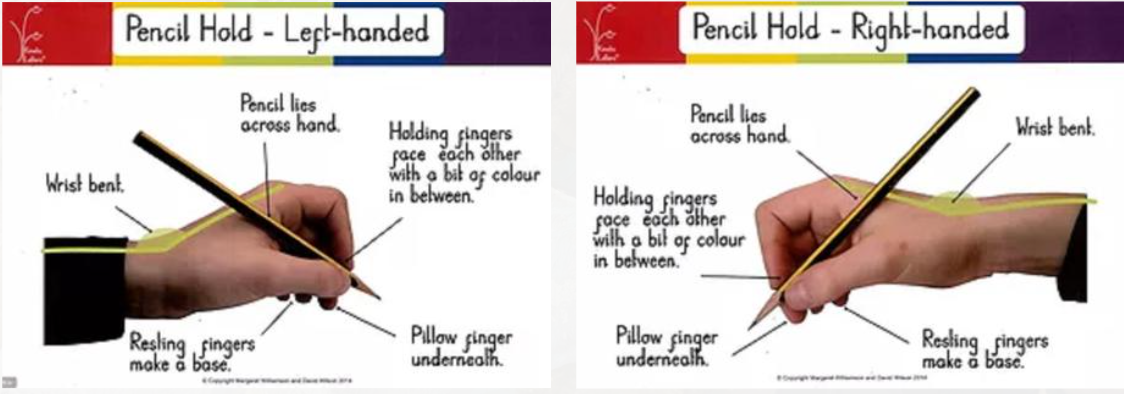
Holding the pencil – mastering a comfortable and efficient pencil grip
The pencil/pen grip must be comfortable to allow writing for long periods. Pens and pencils with a triangular cross-section assist in developing the correct hold.
-
Learning the letters – forming each letter accurately according to a simple, clear set of rules
The movements to form the letters begin with whole body movements and progress through writing on sand trays to writing on whiteboards and finally writing on paper. Letters are grouped into letter families. Each letter family is introduced to the children through a story about two monkeys called Bounce and Skip. Bounce is a brave monkey who goes to the top branch of the tree and helps write the tall letters, whilst skip is a scared monkey who goes to the lower branch and helps write the other letters.
-
Flow and fluency – developing smooth, legible, and connected handwriting
Letter movements are minimised to help a fast writing style to develop. There are no lead-in strokes.
The Kinetic Letters font covers the entire alphabet and is designed with simple, consistent rules to enable fast and effective learning. The sequence in which letters are introduced is carefully planned to match the cognitive development of children, ensuring they build confidence and skill step by step.
What does a handwriting session look like?
In a handwriting session at Verwood C of E First School, children are first introduced to a letter family. To begin, they use their whole bodies to “air write” the letters, engaging their arms and core to build muscle memory and control. Next, children practise forming the letters on a sand tray or a special Kinetic Letters whiteboard, giving them a tactile, hands-on experience. Once they are confident with the shapes, they transfer their learning onto paper.
Children are systematically taught all Kinetic Letters families, as well as uppercase letters and numbers. Once they can form letters correctly, starting and finishing in the right place, they move on to joining their writing using the Kinetic Letters joining programme, developing fluency and a smooth, legible handwriting style.